

The Rise of Regenerative Design :: A Positive Force For Change
Regenerative Design is being defined and promoted by the American Institute of Architects, with usable guidance available later this year. These concepts are timely in our need to address weather extremes, resiliency, and create low impact environments.
The use of this process adds triple bottom line value to our projects and adds value to our services as an industry.
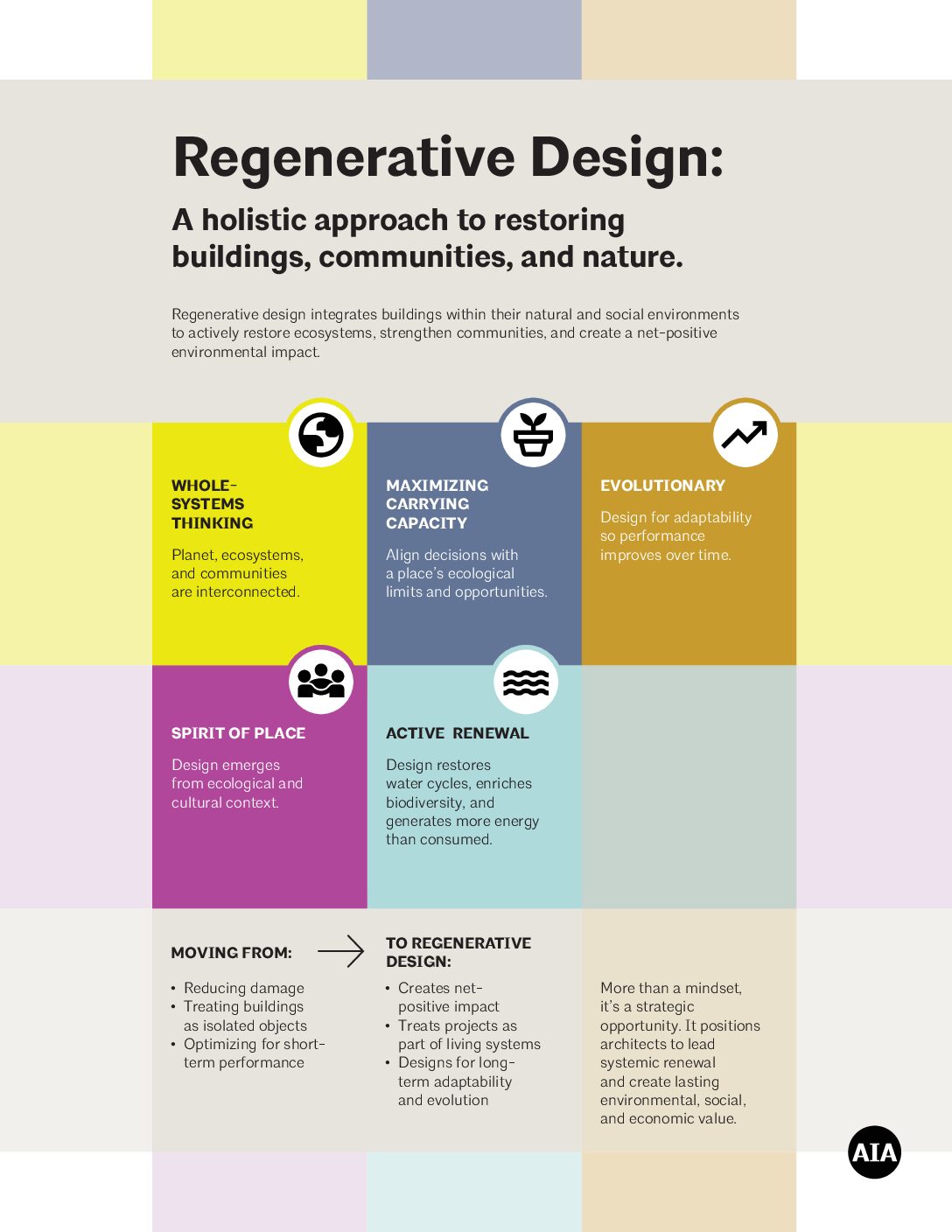
Graphic Courtesy of the American Institute of Architects
If we’re serious about 2030, we have to design systems that evolve and improve—not just buildings that check a box on day one.
Climate science is clear and the built environment is a major contributor to emissions. At the same time, we’re seeing the social impacts of inequity, disinvestment, and environmental injustice. Regenerative design addresses both—it’s a more complete response to the challenges we’re facing.
Regenerative Design creates a paradigm where design decisions are considered in their larger community and ecological contexts using five principles:
- Thinking in whole systems to evaluate their interconnectedness.
- Working with the carrying capacities of specific sites.
- Recognizing the need for design to learn from results and improve over time.
- Letting design emerge from the site’s ecological and cultural context.
- Work to restore hydrology, eliminate waste, generate energy and enhance
biodiversity.
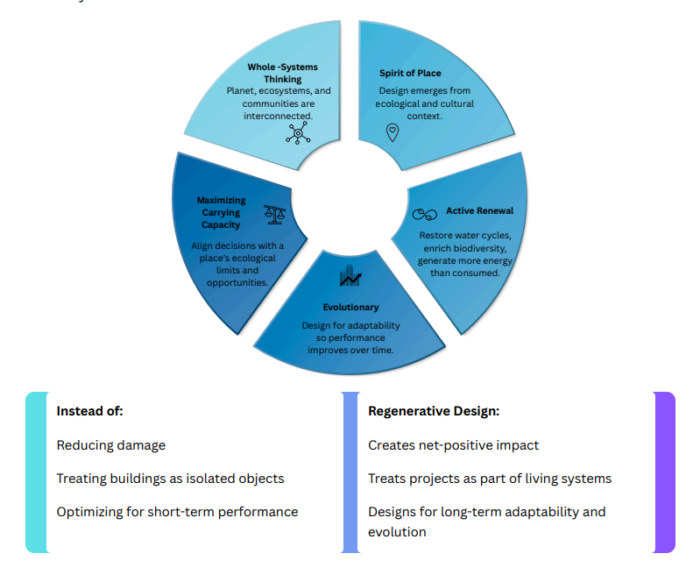
Graphic Courtesy of the American Institute of Architects
Buildings don’t exist in isolation. They’re connected to ecosystems, infrastructure, and communities. Regenerative design looks at those relationships—how water moves through a site, how energy is generated and used, how people interact with space. When you understand those connections, you can design solutions that create multiple benefits at once. That means engaging communities early, understanding local needs, and designing in a way that creates opportunity—whether that’s better health outcomes, access to resources, or economic resilience.
The act of designing responsibly requires an understanding of the larger scale and time-
bound impacts of design decisions. This paradigm enables us to shift our thinking to:
- move from doing less harm to creating positive impact
- think of cyclic and circular resource use, rather than single-use linear extraction
- use triple bottom line thinking as validation for design decisions
- favor long term value thinking rather than immediate returns.
- work toward long term adaptability and resolution
Further, this working definition of Regenerative Design works well with the Framework for Design Excellence and provides guidance in resiliency planning.
Regenerative Design is not a trend. It is a shift in mindset. As our communities face increasing environmental, social, and economic pressures, the opportunity before us is no longer simply to sustain what exists, but to design systems that actively restore, reconnect, and regenerate. The question is no longer how do we minimize harm — it’s how much good can design do?